Category Archives: Papillion Interview

Papillion Interview: Tommy’s Car Wash, Part One

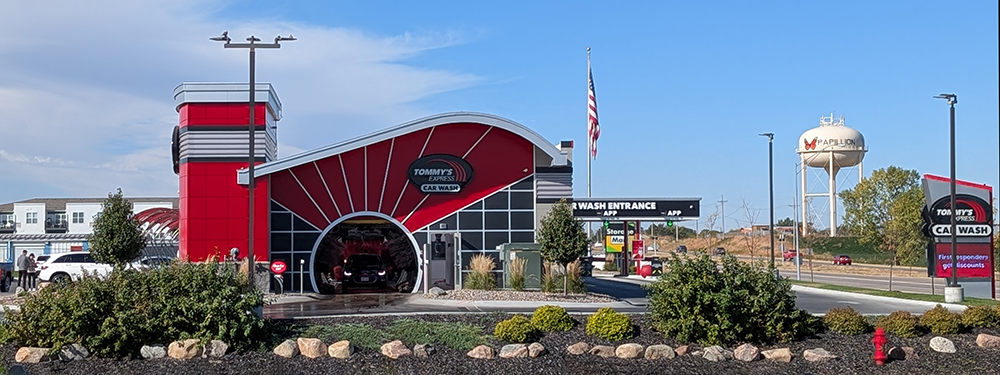
Exterior view of Tommy’s Car Wash

PapillionBusinesses.com Interview with Jeremy Eickman  and Keagan Glazebrook  of Tommy’s Express Car Wash Papillion
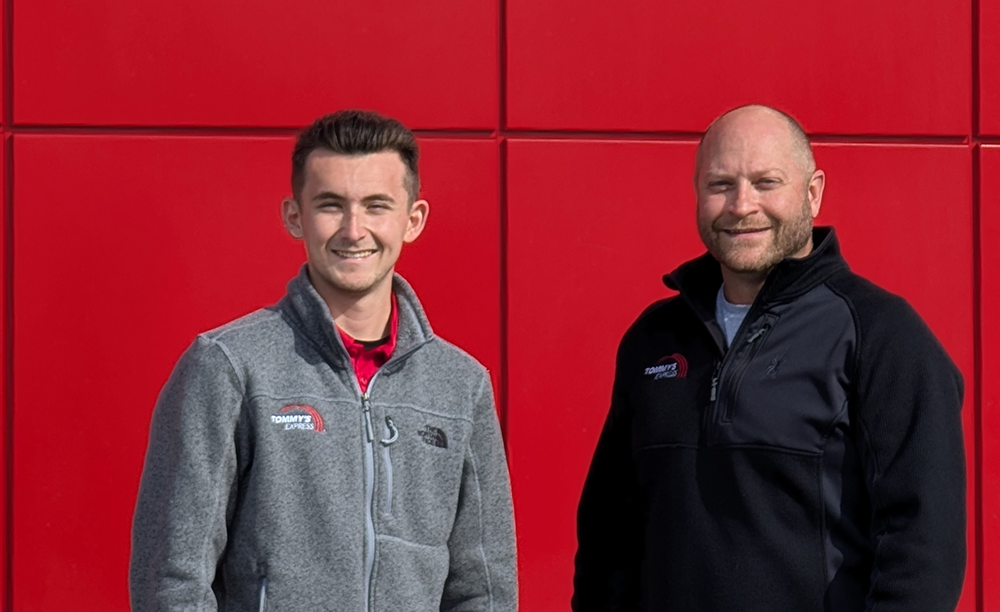
Keagan Glazebrook  (left) and Jeremy Eickman (right)

Jeremy Eickman: My name is Jeremy Eickman, and I’m one of the owners here at the car wash.

Keagan Glazebrook: My name is Keagan Glazebrook. I am the general manager here at Tommy’s Express Papillion.

Jeremy Eickman: All right. So yeah, we’ve been in business here a little over two years. We opened in September of ’22. We grew pretty fast right out of the gate. This area was kind of an underserved area for the car washes, and obviously that’s kind of changed, and we touched on that a little bit ago with the fact that there’s a lot of car washes opening. There are continuing to be a lot of car washes opening. On average throughout the day in the summer, we wash around 700 cars a day, and in the winter we wash over 1000. So the industry being, quote, saturated, I would say isn’t really the case; there’s still a high demand for automated car washes. I think a lot of people really enjoy the convenience of an automated car wash, where they could be in and out in three to four minutes rather than spending an hour in their driveway or going to a park-and-spray-it-off car wash and spending a good 30 minutes and probably not getting the same kind of quality product that we put out here.

That’s what really differentiates us between even our competitors in the Express space is that we really focus on our detergent quality, the pH levels, all of the chemistry that goes into creating a good- quality wash because there’s different soaps that hit your car at different times. And we train all of our staff to understand the value of that and how to modify that, where we’ve actually employed a lot of those same folks that come from other car washes where that’s not even a topic of conversation. It’s just throughput: get them through, get them through. So our focus, I believe, is more on quality and less on just throughput. We slow our belt down to ensure that we have good-quality product. Even though we could increase it and put more cars through faster, we enjoy the quality aspect of what we do.

Thank you. I’ve got a very good car wash here.

Jeremy Eickman: There’s certainly a difference between the different brands in town and the way everybody approaches it. We also have an app that you can completely customize your entire experience here. You can sign up for all sorts of things. You get rewards back for referrals. I believe we’re the only one in town that has an actual app, not just a random website that you sign up on. So you can control your members, you can pause it, you can cancel it, you can sign up multiple vehicles. You can do everything from the app without having to worry about “Did my change actually take place? Because I called the store and I don’t know if that actually happened.” And so you’re in a lot more control with our business than maybe at other competitors.

Tell me a little bit about Tommy’s and where it started and why Papillion and this location was chosen.

Jeremy Eickman: Sure. So, Tommy’s, the brand in general, started in Holland, Michigan 20-some years ago. They were flying the flag Quality Car Wash brand, but they were creating their own equipment. And one of the owners of that business’s name was Tom, and so they called their equipment line Tommy’s Car Wash Systems. And then about in 2016 they decided to start franchising the model as an all-in-one package. So instead of most car washes buying their equipment from one supplier or building from another place and getting all their different pieces from many different suppliers, now with Tommy’s, it’s, like, a franchise where you get everything from one supplier, one-stop shop. So as an operation side of things, if you have problems or you need replacement equipment, you have one place to go to get it, which makes our operation went a lot smoother and quicker, less down time, less finger pointing when equipment doesn’t work and whose fault is it. And so that model really helps us grow, just like any franchises you see. from McDonald’s next door to us here to you know, other places, other restaurants or whatever it be, the franchise model really works well. So we can still be in local ownership. We are. We live here in the community; we are local owners. We just have a franchise brand that we use, but all of our employees are from here. We’re really strong in the community with fundraising. We employ about 20 people. We obviously supply quite a bit of tax revenue to the city as well, and we like to think that our facility stands out and is very nice and clean and aesthetically pleasing, not a dilapidated car wash that’s got trash all around it.

I’ve been through quite a few of the dilapidated ones.

Jeremy Eickman: Sure. And to rewind, I think that’s why our model works so well, because people they want better and they deserve better and sometimes…I’m not pointing fingers at any car washes specifically, but if you kind of let things go and maybe don’t change and modify your equipment and get better technology as something new comes out… and consumers want a better product. We can supply that, and maybe other car washes felt like they just didn’t need to modify and change with the times. And if you imagine if every industry just didn’t change, we would have a pretty archaic society today, you know? And so we’re really all about our technology improving the way that our car wash   can work efficiently and quality and all that.

What did you do before coming here?

Jeremy Eickman: Before this I was involved in franchising with Jimmy John’s. I worked for a franchise partner who had about 50 different restaurants in four different markets. We had Omaha here, as well as Florida and a few different markets. And so we were familiar with the way franchising works and that whole community of franchising. And then we were able to take that same kind of approach to running those restaurants and then…really just a different product, but same type of management structure and employee morale and all that. We focus on our culture to be really strong here, and it’s really worked. It’s really worked well here, and we’re growing more on the franchise. The Tommy’s Express brand in Omaha is kind of divided up between two different franchisees. We have the Sarpy County market and in Pottawattamie over in Council Bluffs. And then the other group has the northern part of Omaha. So we work together and that way our pricing is the same and our operation hours and a lot of that is the same. Obviously our product that we’re putting out is the same, but there are separate owners. So we’re growing here. We’ve got two more locations that we’re going to open in this area, one in Bellevue and one over on 204th and Q, and then we’ve got two opening up in Council Bluffs in the next couple of years. One actually opens up in November.

Where is that one?

Jeremy Eickman: Menards built a new location on built on Madison Ave. So over by the new HyVee… the old Mall of the Bluffs, I should say. If you know where the Mall of the Bluffs is, that whole area got redeveloped by Menards. There’s a new HyVee there, and we’re right next to. Menards as well. So that’s our next location that’ll open, and then we open up at 204th and Q sometime around the January, February time frame. And then Bellevue will open up on 31st and 370 probably in June.

You’ve been in franchising for a long time. What do you consider the advantages of owning and operating a franchise? And any advice for people thinking about it?

Jeremy Eickman: Two really important things come through franchising… is brand recognition, because typically unless you’re in the early days, which we did get in on Tommy’s in the very early days when n obody knew the brand. In 2018 is when I got started with Tommy’s and I was in Florida doing some there before we opened this one. And so when you…but usually you have an established brand. Jimmy John’s is a great example of this, where that brand was already pretty popular. You know, Chick-fil-A is a great example of cult-following brands—people who all go crazy when one of those comes down. And so you get the benefit of the brand recognition before you open, typically.

And then secondly, you have the support behind you. So if you’re running a Tommy’s, for example, we know that we have our corporate partner who can supply us the products that we need. They can negotiate things so we can get a better deal on it, whether it be a product or we are always doing test research to come up with better products, better throughput, whatever we can do to make the experience better. We don’t have to invest all that ourselves. They do that. Now, we do pay a percentage of our revenue for that. But as a one- or two-store operator, you would never be able to afford a research and development department to that size, and so you get an economy of scale without having to put all of your own money into that. Well, that’s a major benefit.

There’s other intangibles, too. When it comes to that, people want to work for a brand they recognize. So by default, employees may feel a bit more comfortable about working for Tommy’s Express than Jack’s Back Street Car Wash. I’m not discounting that at all, but we are still local owners.

Jeremy Eickman: Sure. Thank you for that. Yeah, but the brand really does hold true. It helps the consumer feel comfortable and confident about that they’re going to get a good product and we’re going to stand behind it, and the employees feel really good to think about working for a brand that they are proud work for.

Keagan, could you tell us a little bit about how you came to Tommy’s and anything else you’d like to add coming up.

Keagan Glazebrook: I came to Tommy’s when this store was being built. I tried to walk on site and there were fences around it and I got denied. Then applications came out and I applied, came in and met Jeremy, and we had a good interview, and we ended up working together, and here we are today two years later.

Jeremy Eickman: Keagan worked himself up from a basically a team member of the car wash to the general manager within a year, and that’s extremely fast growth. He’s a very, very strong individual. We’re very happy to have him.

Keagan Glazebrook: Yeah, working for Tommy’s I’d say is very pleasing. I have a big support group behind myself within the franchise partners and the brand. It’s very family orientated. Anything that I’ve ever asked or needed is proposed right then and there for me, and I have nothing but good things to say.
Papillion Interview: Suzie Bonnett of Chocolaterie Stam

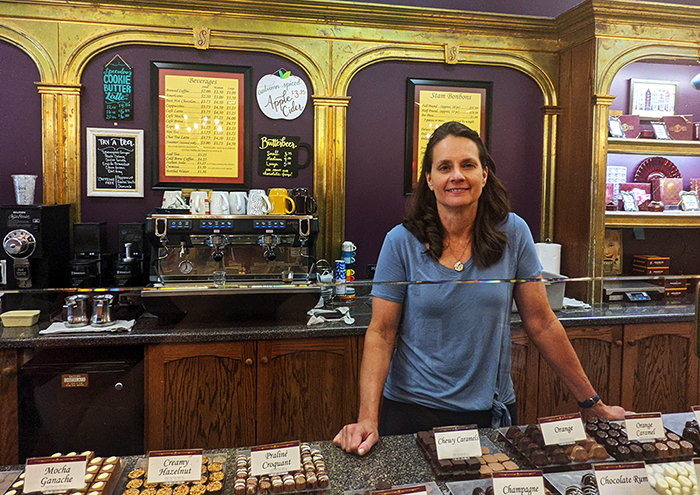
PapillionBusinesses.com Interviews Suzie Bonnett, Owner of Chocolaterie Stam in Papillion

I always love coming to your shop and always find something new and wonderful, besides my old favorites.

How did you end up owning the store? 

The story I always tell, and it’s true, is when we had the opportunity to live in Europe for five years, in Germany, we discovered Belgian chocolate… good chocolate, real chocolate, and gelato, and nice coffees over there, too. And so when we came back to the States we missed all that, of course. And I have some sisters and sisters-in-law that live in Des Moines, and that’s where Stam, the United States, is based. And so they took me to one of those stores when we first got back from Europe, telling me that that’s the same chocolate that I had overseas. And I didn’t believe them, of course. And of course it is. It is the same, because Mr. Stam imports his chocolate blocks from a chocolatier over there, following his recipe that’s over 100 years old, and so he makes all of it right there in Des Moines.

I called Mr. Stam out of the blue one day about 16 years ago now, asking if he ever franchised and if he wanted to be in the Omaha area, and he said yes to both of those. So we opened in November of 2009 here in Shadow Lake and Papillion, and we’ve been in the same slot the whole time, even though people find us every day asking how long have we been here and did we move and is this new and all those things. No, we’ve been here…we’re going to turn 15 years old now here. And this November, we’re going to have a big Open House party.

It’s beautiful. Beautiful curtains, drapery, chandeliers, everything… that just gives the right ambience to such a special chocolate.

Right.

We didn’t have anything like this in Papillion for quite a while. How did you end up picking Papillion and this area?

Well, I live in Bellevue and at the time, the kids were all still home, living home and going to school in Papillion schools. So the girls went to Papillion South and then Devin was still at Papillion Junior. So this was kind of equidistant between me having to drive to the high school all the time for events. And then, living over in Bellevue, Chad worked on base at the time. He’s my husband and he’s since retired. But that was a good spot for us to live. And then the kids were all there. This slot was available in November of ’09 and it had never been built out yet, so we thought this was a perfect spot. Shadow Lake is a nice mall. They keep it up nice. It’s a beautiful mall, and we wanted to be on this side of the street where the sun would show on us but not bake us. And then we’re right beside Bath and Body, right across the street from Victoria’s Secret and right beside Kay Jewelers. So we’re on the women’s end of the mall, I thought. And so it worked out.

Any advice or things that you learned from being in business so long? And then starting right after the typical year given to the recession of 2008, and then 2020 COVID… you had a lot to go through besides just regular life.

There was a lot. Just besides, yes, having three kids going through high school and getting ready for college and coming out of the recession, not being able to get any bank to talk to me. Funding was a big challenge. I seriously think I went to 17 banks and they all said no. And so I said, “Well, Mr. Stam, I don’t  know how this is gonna work.” But he said, “Well, we’ll figure it out.” And so with a little creative financing there, and we had some savings. Yeah, it was a risk, but small business is always a risk. And it got off the ground and it stood by itself. Within three or four years it was doing fine. We get through our first ten years, and in year 11, COVID hits. And quite frankly, COVID was good for us because we have the type of product that people want when they are stressed and worried and can’t go anywhere and want to gift each other good-feeling things, and it helped us. It helped certain businesses. I know it crushed others, and we were just lucky that way. But we have come off that high where we’ve slipped a little bit back, but we’re still doing just fine. You just never know what’s going to walk in the door every day in a small business. It’s a lot like teaching, which I did briefly before this. You’re always pivoting, you’re always changing, you’re always thinking ahead, you’re always planning, and hopefully things go well. They don’t always. We’ve tried different products in here, of course, that have flopped, and we’ve tried things that have really taken off. So now we’ve got to keep up with it.

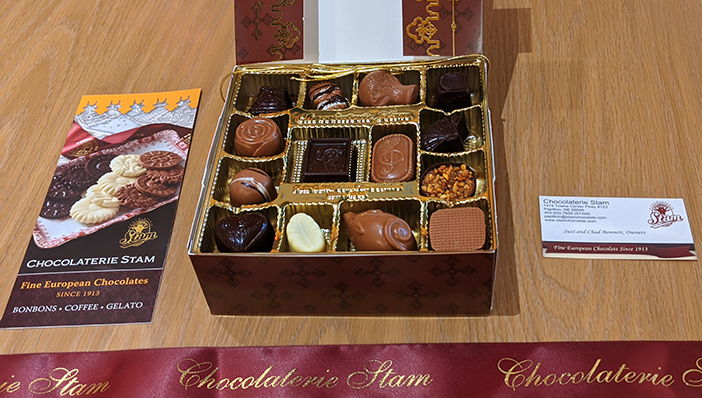
Table with burgandy and gold ribbon with text, “Chocolaterie Stam’ and there items(brochure box of chocolates.,business card).

So what are some of people’s favorite products? And then what do you have coming up here for fall, which is one of my favorite chocolate times. Actually, before Christmas and the holiday giving, I really love your fall…

The fall line is yes, definitely coming up, and of all the lines, I think it might be the favorite. It’s beautiful, it’s by far the prettiest chocolates that Stam makes. They’re all in the shape of leaves and nuts and grapes and things like that. They call it the fall harvest line. We stick to the seasons. I don’t have my fall even yet, and it’s September 10, but it’s very soon here and we won’t have Christmas until fall is pretty much gone. Caramel apples are going to start. We don’t do them year-round; we only do them in the fall. We try to keep that very European tradition of let’s don’t rush the seasons. Let’s honor each holiday and each season. We actually are going to have things specifically for Thanksgiving. It gets left out anymore, between Halloween that started in August and then Christmas comes right in as soon as Halloween is over. November 1st it’s all Christmas stuff. But no, we have some specific chocolates for Thanksgiving here. I think the seasonal stuff is the favorite in the chocolates.

Gelato—we make that here.

Your gelato is amazing.

And that’s become more and more popular every year. We make more and more gelato every year, and so that’s been a nice surprise. We didn’t really know how that would go, but there’s very little gelato—actual gelato—in the whole Omaha area, so when people find out what it is, which we are constantly educating on what it is, and when they find out what it is, it’s a great product.

What makes it authentic or actual gelato?

So gelato, the big difference between it and ice cream is a question we get every day… is gelato is made with milk instead of cream. By law, in the United States to be considered ice cream, it has to be at least 10% butter fat. Some of those really high fatty ones, the decadent ones, they come in around almost 20%, so ice cream can be very fatty. It makes it good, or course. Gelato is around 3 or 4%. It’s really low-fat, but it doesn’t taste that way because the way it’s churned in the bag, it hardly has any air whipped into it, so it’s very dense, which makes it seem creamier, even though it’s very low fat. It all has sugar in it, but it’s low-fat. Now, we also have some no-fat—the non-dairy ones, and those are technically sorbettos—sorbet, sorbetto, English, Italian—and they are no-fat, no-dairy. Generally they’re fruity ones, but we’ve developed some nice chocolate ones. We have a root beer in there right now. He’s done a coffee one that’s non-dairy, so we have lots of non-dairy options in this store.

Including some non-dairy chocolates as well. 

Yes, dark chocolate covered nuts, dark chocolate covered orange peel. We have a dark chocolate covered raspberry and then just solid bars and chips and yeah. So we have a big allergens list. I have a whole big folder of what’s in everything. And since we make the gelato, we certainly have total control over what’s in that. And then also are the chocolates: I know who made it when it was made and what’s in it, because I’m in contact with Mr. Stam all the time. All the time.

Is there a question you would have wished I asked and didn’t ask, or something you want to share or promote?

Let’s see how to…other than the maple chocolate I’m looking forward to… How to drum up more business. That’s always on the mind of any small business owner. As we’re getting close to holiday time, I’m always wanting to get a hold of more corporations and get in their ear about corporate gifts. That’s been a big challenge for me over the years.

I’ve been here quite a lot over the years…I think when you first opened as well. And to me this is just like the quintessential corporate gifting.

Yeah, I agree.

And the gifting to anybody, it’s not something they’re going to be opening up on any other holidays or birthdays. And if anyone is giving chocolate, this is the wow chocolate.

Yeah, chocolate is the thing to do.

So what kind of corporate gifts…ideas…do you have? 

We can do any size box, from your little two-piece favor up to your giant 80-piece suitcase box, we call it, and within those you can totally choose if you want all dark chocolate, no nuts, no alcohol. You can really personalize that. And on top of that, you can get your logo printed on the chocolates, if you have the rights to it, of course. And we’ve had lots of different corporations and groups and squadrons on the base and over the years do that, and it really looks sharp. Their logos really stand out. Then you brand that box yours, and it’s still a Stam chocolate box because of course we’re going to have branding on our boxes. So it works both for getting Stam chocolate into people’s mouths and them realizing, oh, it’s from my employer, or my banker, or my financial planner.

I’ve done the logo chocolates with you before, and those were very nice. 

Yeah, that’s right. So that’s just a little extra thing, and on top of being able to pick for your price point, even. Whatever your price point is, we can handle it. We can figure it out.

Any special time needed for ordering things ahead of time, or what type of things and when should they be ordered ahead of time? 

I like a month for the logos. We might be able to ratchet that down a little if Mr. Stam isn’t crazy busy. He can churn those out usually, but a month’s a nice time. We certainly don’t need six months or anything like that. You can walk in, and if we have the non-logo chocolate boxes, we can make those, as many as you want.

Thank you. 

Chocolaterie Stam
7474 Towne Center Pkwy #123
Papillion, NE 68046

Papillion Interview: Nebraska Vietnam Veterans Memorial, Part Three

PapillionBusinesses.com Interviews Tom Brown (President) and Ron Elwell (Executive Director) of the Nebraska Vietnam Veterans Memorial Foundation.

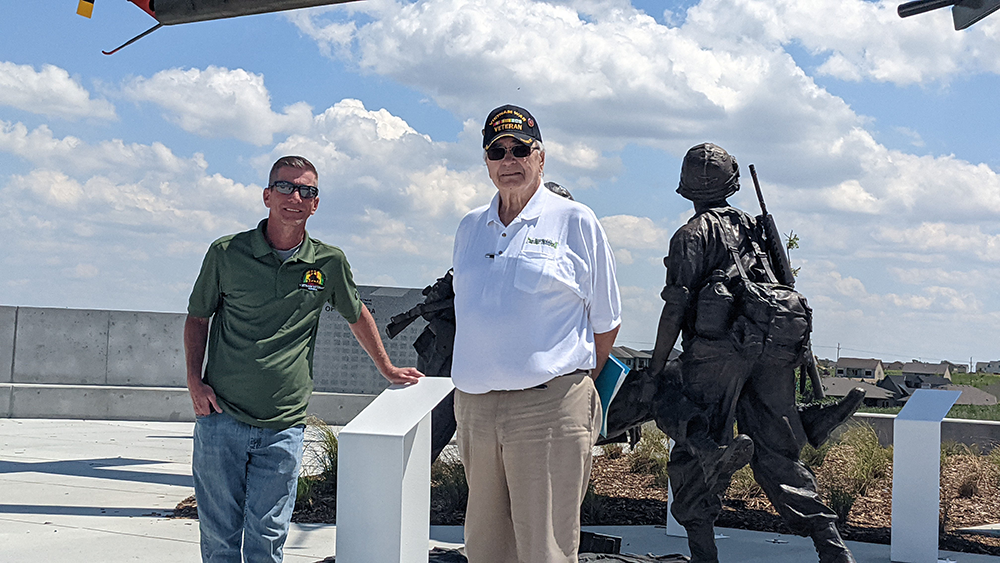
Nebraska Vietnam Veterans Memorial in background with Ron Elwell (left) and Tom Brown (right)

Tell me about the helicopter the statue there to the helicopter.

Tom: One of the major staples of the war in Vietnam was the helicopter. We were fortunate enough to meet Ron. We were doing a fundraiser in Papillion at the Fairfield Inn in there and Ron was there. He was there for the fundraiser. And we were sitting there talking, myself and George Abbott who was our secretary treasurer, and Ron came over and just started talking.

Ron has a tremendous amount of experience working with helicopters and was a helicopter pilot.

Tom: Why don’t you inform our lady here a bit about the helicopter because you did so much of the work on rehabbing the helicopter.

Ron: So, the day I met these guys, I had been retired from the Army. I retired after twenty-two years. I moved back to home. I was from Papillion and moved back and my buddy would always introduce me as a 22-year-old veteran.

So, I introduce myself, “Welcome home and thanks for what you did for me.”

Tom looked at me and asked, “What did you do in the Army?”

I said, “I worked on helicopters.”

He said, “Huh? We have a helicopter. Do you think you could help us?”

And I was like, “Yeah, sure. I started off with Hueys and Cobras.”

He’s like, “We got a Huey.”

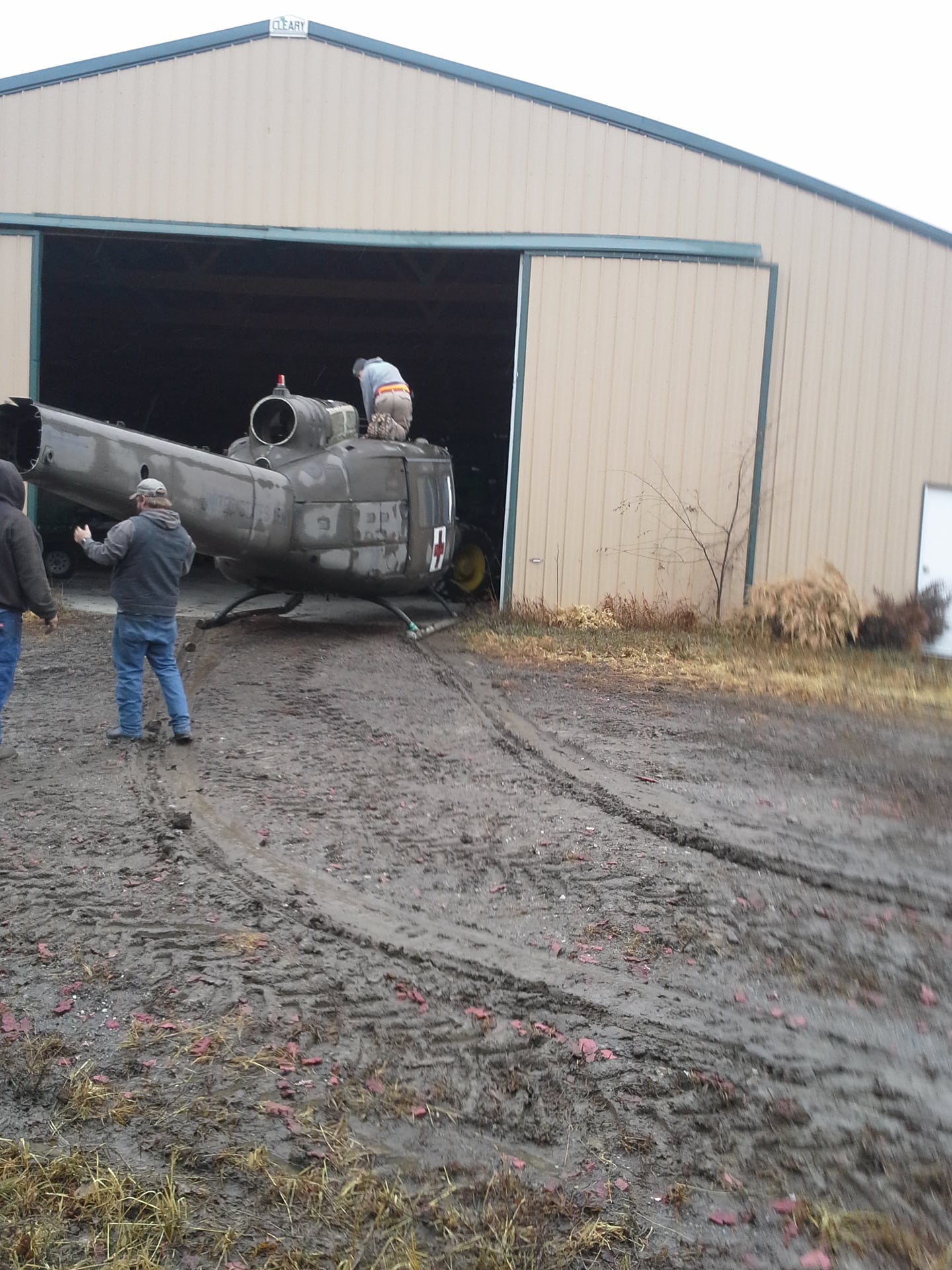
We ended up exchanging numbers. They got a hold of me. [We] call the guy and went to look at the helicopter. I was overwhelmed.  The helicopter looks nothing like he does right now. It was in shambles. The tail was cut off with a saw.

Photograph Courtesy of Nebraska Vietnam Veterans Memorial Fund, Damaged helicopter with tail sawed off being moved through mud

Why?

Ron: That’s how they transported it.

Tom: They had to get it on a truck and it wasn’t going to fit with that tail on it there, so they cut it.

Ron: Except there were only 4 bolts on there. They could have removed them, so it was no big deal. But that was a big deal. It didn’t have rotaries. It did not have a transmission … It was just pretty much just a shell of a helicopter.

Tom: . . . and don’t steal it because it ain’t got an engine!

Ron: So I was pretty overwhelmed. And it [helicopter] was at Iowa Western. The director of aviation maintenance program was kind of taking the lead on it. He’s like, “I don’t know first thing about helicopters.”

“That’s all right,” I said, “we’ll work through it.”

He actually was using a model kit. He was using the instructions as to how the helicopter was supposed to go together. He was using some of the Iowa Western students to help restore it. So, about a year?

Tom: Yes.

Ron: Right, about a year.

Got it all hemmed up, put it all together and it is what you see today, in midway . . . in between getting it fully restored. We’ve probably, I would say, there’s probably, easily, ten thousand hours in building the helicopter and to get back together between all the manpower we used.

About midway when we were getting done, we get a phone call from George Abbot. He said, “Hey, what’s the full tail number for the aircraft? [Do you] have a tail number to the helicopter?”

I said, “Well, 68-15532.”

He’s like, “I think we found the original crew chief from 1968!”

No way!

Tom: Yes, way!

Ron: I said, “George, your full of it. There’s no way. I don’t believe that.”

He’s like, “I am telling you. I need you to contact this guy and vet him and see if he’s the real deal.”

Well, there’s a lady that runs our education history committee Her name is Dottie Barickman. And I called her and she said, “Oh yeah, this guy has logged journals, over a couple 1000 pages of journals and over a couple of 1000 pages of pictures.”

Tom: He recorded everything while he was there.

No way

Tom: Everything.

Ron: So, he was the original crew chief. Come to find out all the original crew members were still alive. This helicopter only had about 3500 hours on it from his time in Vietnam. Well, Craig, the original crew chief, got this helicopter on his birthday, May 4th of 1968, on his 21st birthday. He got this helicopter because his was blown up. He’s got pictures of receiving his helicopter. He flew it for a year and a half because he, like Tom, extended six months and all the other guys had flown it multiple times. There’s only one of them no longer living. He died from complications from Agent Orange before he could see it.

We finished that. We had all agreed that it’s probably a good idea to do a reveal for them they had not seen the helicopter in more than 50 years.

Nor had they been together in fifty plus years. We did make a big deal of it. They all flew out came in and they saw the helicopter for the first time, completely redone as you see today.

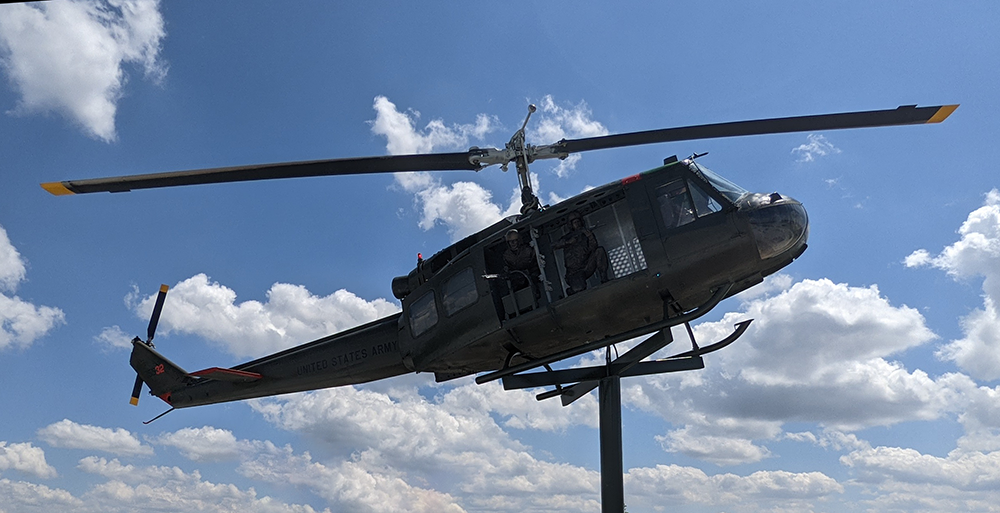
Originally, the plan was to make it a medevac and show it medically lifting somebody. When we figured out the story was, “Hey, this helicopter was not a medevac. It was a command-and-control bird.” I had him send me all the pictures on this aircraft and I painted it just like it was in 1968 including the nose arc with Snoopy. So, everything is just like it was in 1968. I’m still doing a little bit of work, I’ve got to do here next week, but it looks just like it did in 1968 when he got the helicopter.

Restored helicopter mounted on pole at the Nebraska Vietnam Veterans Memorial

Congratulations. It’s amazing

Ron: The whole crew will be out here. The whole crew’s coming out here minus the one, he passed away from Agent Orange complications, but his family will be out here for the dedication. They’ve seen it once. They had not seen it, not up on a pole like it is, so it’s a pretty, pretty big deal.

That was a pretty emotional day when we revealed the helicopter for them to just be able to sit in it for the first time in 55 some years. But it’s truly made it worth every ounce of effort for what we put into the helicopter.

The statues are all modeled after some of the Air Force personnel from Offutt. Those are all actual people, airmen from Offutt that came out to do the modeling. The gun that’s mounted in there, that was an addition because the medevac didn’t have guns.

When we figured out command and control, I had the sculptor [make a] mock up and we got measurements for the original guns, so they mocked all that out. It’s all exactly the way it worked, like in 1968.

There are two pilots up front inside there. There are those statuaries there and there’s a sound system. It’s not working yet. It’s installed. We are just waiting on a part and you’ll be able to hit the button and you’ll hear the Huey actually hovering over top of top of you. If you ask any Vietnam veteran, they will tell you the Huey sound is very iconic. And to this day, most Vietnam veterans can tell you when a Huey is 3, 4, 10 miles out and they can hear that sound and just know that it is a Huey to come out and get them.

We incorporated the sound and started making the lights work. Me and the guy from Iowa Western decided, we are like, “Hey, let’s make all the lights work,” so we did! We made them all work and put it all back together. On January 31, it moved here. About two months later we mounted it on the pole.

We made some adjustments on the rotors, so they don’t fly. We’ve adjusted a lot of stuff to make sure that it’s not trying to lift off, just minor things. The helicopter’s attracted a lot of attention.

Tom: Why don’t you tell the lady how it got here?

Ron: Yes

Tom: We’ve got a story behind how we actually got the helicopter.

Ron: So these guys . . . I always like to tell when they came up with this idea … they were drinking a beer . . .

Tom: . . . or two.

Ron: . . . and telling war stories and just had a good idea. Tom knows most Vietnam veterans throughout the entire nation. He’s got a connection to somebody somewhere in any state. I would probably say, probably the world at this point, but Tom had a friend. Was it at the VFW?

Tom: Vietnam Veterans of America out of Vermont

Ron: They had this helicopter sitting in Vermont just basically waiting to be restored and they couldn’t figure out how to raise the funds to restore it. Tom was talking to him one day. He’s like, “Hello [I’m] looking for helicopters.”

“Okay, I got like one. You guys want it, come get it. Just pay for transportation. It’s yours.”

Tom is like, “Done, I got that covered.”

Tom: Sold American.

Ron: Again, sitting around drinking a beer. Hey, we’re gonna move that. It was in Bennington, Vermont. They drove up there, loaded it up and drove it back to Bennington in Nebraska.

And then once he got there, he was like, “Well, what do you do with it? How do we get someplace [to be] restored?” When they talked with Iowa Western in Iowa, the guy at Iowa Western jumped on board like, “Hey, well, we’d like to take on that project with our students and try and help out,” so it got moved from Bennington to Iowa Western. That’s where I got involved with it

So, the whole story of that helicopter . . . it’s just every time we turn around, it gets more and more interesting. There are connections right now that we know about that we haven’t or will put out eventually one day in the near future, but there are connections to that helicopter and some of the folks that are memorialized on the wall.

Wow

Ron: That very same helicopter. The connections between that helicopter out there. It’s just unbelievable. One of the pilots, he’s a Silver Star recipient. His nephew actually lives here. They didn’t know about the helicopter. They actually found it from a magazine, DVAs magazine. They saw it. One of the pilots saw sent it to Craig like, “Hey, isn’t that our helicopter?”

He’s like, “Yep, that’s our helicopter.” And they figured out how to get in contact with us which was with Dottie. And from there it was just history. The strange connections seem to just keep happening.

That’s beautiful.

Ron: It’s very beautiful.

Every Vietnam veteran, I don’t care what branch of service they served there, they all know that Huey. They all [know] that significance.

I tell everybody like that was really the first time we used helicopters to the extent that we did was in Vietnam.

Korea, you had a few just as medevacs and stuff, but Vietnam is where we learned how to do helicopter operations. When I was in the Army, when I first got in a lot of our tactics were based off of Vietnam tactics.

That is where it all started with that helicopter right there.

Tom: The two soldiers, that was all done here. But that’s symbolic of what we do in Vietnam, you’re medevacing a wounded soldier. And in Vietnam, that’s how you get your supplies, your food, your ammo.

That’s how you medevac. There were no trucks and stuff like that. You don’t drive trucks through the jungle. That just don’t happen.

Ron: Yeah

Tom: or land mines. It’s not a real good idea.

Ron: All the sculptures have been done by a local artist. He actually helps veterans. His name is Troy Muller.

He’s done a fantastic job with all the sculptures. Most things are Vermont granite which is ironic, that’s where the helicopter is from too.

Everything is locally sourced. Either US sourced or locally sourced. We’re using all the monuments, the engraving and stuff are all done by companies in West Point, Nebraska. And then our memorial honor wall was all the same. The granite, that was the thing that cost the most and took the longest.

Tom: We got a million pounds of granite here.

Wow.

Tom: That relates back about $2 million. Yeah. Yes. It’s a lot of fundraising.

Ron:  Each one of those weighs 20,000 pounds apiece.

The twenty-five-foot wall that came out in one section. The quarry flooded when Vermont got flooded. The quarry was completely flooded so they couldn’t get the granite out. So that that held us up a little bit trying to get the granite delivered.

I want to say that 24 foot granite wall, I want to say that being is right at almost 100,000 pounds.

Thank you both very much.

Come and see the Nebraska Vietnam Veterans Memorial for yourself at the ceremony on 6 June!

Get tickets and learn more here:
https://nvvmf.org/

Nebraska Vietnam Veterans Memorial
11691 South 108th Street
Papillion NE, 68046